
World Language education in Maine prepares every student to communicate with confidence, connect across cultures, and thrive in a global society. Guided by the 5 Cs of the Maine Learning Results and aligned with ACTFL’s World Readiness Standards, our programs open pathways to the Seal of Biliteracy, higher education, and meaningful participation in our interconnected world.

World Language Programs in Maine
This interactive map allows users to explore where world language programs are offered across Maine and which languages are taught in each school. By selecting any school point on the map, users can view the SAU information, language offerings, and regional program patterns. The tool supports SAUs, educator preparation programs, and higher-education partners in making data-informed decisions about program expansion, recruitment needs, and long-term language-learning pathways aligned to the Maine Seal of Biliteracy.
The data presented in this map is based on information provided by the individual SAUs as of Autumn 2025. This data will be refreshed on an annual basis.
The Importance of World Language
Students learn to share ideas, express feelings, and understand others in another language, both in conversation and writing.
- Use authentic conversations: incorporate role plays, interviews, and debates in the target language.
- Leverage technology: record voice or video reflections to build fluency and self-expression.
- Practice interpretive skills: read news, listen to podcasts, and watch media in the target language.
- Encourage writing for purpose: journals, letters, or emails to real or simulated audiences.
- Provide feedback cycles: peer review and teacher conferencing to refine speaking and writing.
Language study opens doors to traditions, perspectives, and practices from around the world, helping students see beyond their own experience.
- Engage with authentic resources: music, film, food, and literature from the target culture.
- Celebrate cultural events: organize school-wide cultural festivals or virtual exchanges.
- Connect with native speakers: bring in guest speakers or partner with classrooms abroad.
- Study cultural practices: explore traditions, rituals, and daily life routines.
- Compare perspectives: discuss how cultural values shape viewpoints and behavior.
World languages connect learning across disciplines: science, history, art, and more. This enriches academic growth and expanding knowledge.
- Integrate cross-disciplinary projects: link language learning to history, science, or art.
- Use real-world materials: menus, travel guides, maps, or scientific articles in the target language.
- Partner with other subject teachers: co-create units that blend language and content learning.
- Explore current global issues: research climate change, migration, or technology trends through multiple languages.
- Encourage career links: invite professionals who use world languages in their work.
By comparing languages and cultures, students gain a deeper understanding of how language works and a richer perspective on their own identities.
- Compare grammar and vocabulary: highlight similarities and differences with English and other languages.
- Analyze idioms and sayings: explore cultural meaning behind common expressions.
- Explore nonverbal communication: gestures, body language, and etiquette across cultures.
- Contrast texts/media: compare how stories, news, or advertisements differ by culture.
- Reflect on identity: encourage students to consider how learning another language shapes their perspective.
Students apply language skills in their schools, local communities, and the wider world, becoming lifelong learners and global citizens.
-
Create service- learning opportunities: volunteer with local multilingual organizations.
- Build community partnerships: connect with immigrant and heritage language groups in Maine.
- Use digital pen pals: partner with classrooms worldwide via video calls or written exchanges.
- Encourage public performances: language showcases, plays, or presentations for families and community.
- Promote lifelong learning: highlight apps, clubs, or continuing education to extend language use beyond school.
Why Consider the World Language Pathway for the Seal of Biliteracy
Earning the Seal of Biliteracy recognizes your proficiency in English and an additional language, showcasing your commitment to multilingualism and cultural understanding. The World Language pathway highlights your skills in communication, intercultural awareness, and global competency, showcases your skills in communication, intercultural awareness, and global competency, qualities that stand out to colleges, employers, and communities. By pursuing this pathway, you not only celebrate your language abilities but also open doors to academic, professional, and personal opportunities in an increasingly interconnected world. Pathways for Seal of Biliteracy
Understand and respect diverse cultures
- Develop empathy by learning perspectives beyond your own.
- Build skills to interact respectfully in diverse communities.
- Strengthen problem-solving through intercultural collaboration.
- Prepare to engage in global issues like sustainability and diplomacy.
- Become a lifelong learner who values diversity and inclusion.
Employers seek multilingual skills.
- Gain access to more career fields (education, healthcare, business, government).
- Increase competitiveness in a global job market.
- Support Maine’s economy by connecting with international partners.
- Expand customer service and client engagement opportunities.
- Demonstrate adaptability and cultural intelligence valued by employers.
Earn recognition and placement through ACTFL and the Seal.
- Use ACTFL proficiency assessments for placement and credit.
- Leverage the Seal of Biliteracy for advanced college entry opportunities.
- Reduce tuition costs by testing out of introductory courses.
- Strengthen college applications with recognized language credentials.
- Build a foundation for study abroad, dual-degree, and international programs.
Standards
The World Languages Standards in Maine's Learning Results: Parameters for Essential Instruction are closely modeled on the national foreign language standards, which provide further guidance and recommendations for world language programs in grades K-12.
- National Standards for Foreign Language Learning in the 21st Century — an executive summary of the national standards from the American Council on the Teaching of Foreign Languages (ACTFL).
Growing a Language Program
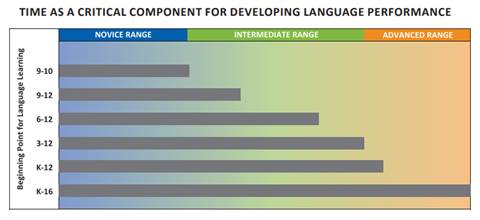
One of ACTFL's Guiding Principles for Language Learning is articulated sequences in language learning. Research tells us that higher levels of language proficiency require a well-articulated and sequential study of a language over an extended period of time. For a myriad of reasons, it is also important for schools to have multiple entry points into the curriculum. The multiple entry points serve to support students who transfer among schools, student choice, and students who choose to study additional languages.
In addition to supporting all of Maine's Guiding Principles, learning another language prepares students to navigate the modern global economy, develops greater cognitive development, leads to greater academic achievement, and develops more positive attitudes toward other cultures. More information about the benefits of learning another language can be found in ACTFL's Guiding Principles for Language Learning and in the research compiled by ACTFL.
Curriculum Resources
A World Language curriculum focuses on two components: building proficiency in the target language and developing global competencies. In developing curriculum, it is recommended that writers use Principles of Backward Design to create standards-based curriculum.
When setting benchmarks for the course's curriculum, there are two major factors to consider. First, how much instructional time will students receive in the target language? Second, which language group does the target language fall into? A student's ability to acquire language will still vary, but these two questions will allow teachers to establish a minimum benchmark for language proficiency.
Unpacking National Standards
In 2012, The Language Educator magazine, published by ACTFL, ran a series of five articles focused on the National Standards for Foreign Language Learning. These articles may prove useful to educators in unpacking standards for their curriculum work.
World Languages Standards Review
The World Languages Standards in Maine's Learning Results: Parameters for Essential Instruction are closely modeled on the national foreign language standards, which provide further guidance and recommendations for world language programs in grades K-12.
- State Standards for World Languages — Maine's Learning Results includes World Languages Standards. Elementary, middle, and high school programming in Maine's publicly supported schools must be aligned to the knowledge and skills described in this document.
- National Standards for Foreign Language Learning in the 21st Century — an executive summary of the national standards from the American Council on the Teaching of Foreign Languages (ACTFL).
- Alignment to Common Core State Standards (CCSS) — the National Standards for Learning Languages aligns directly to the CCSS for English Language Arts and Literacy in History/Social Studies, Science, and Technical Subjects.
Contact
Melanie Junkins
Multilingual and Bilingual Education Consultant
Email: Melanie.Junkins@maine.gov